Oura Ring vs. Apple Watch
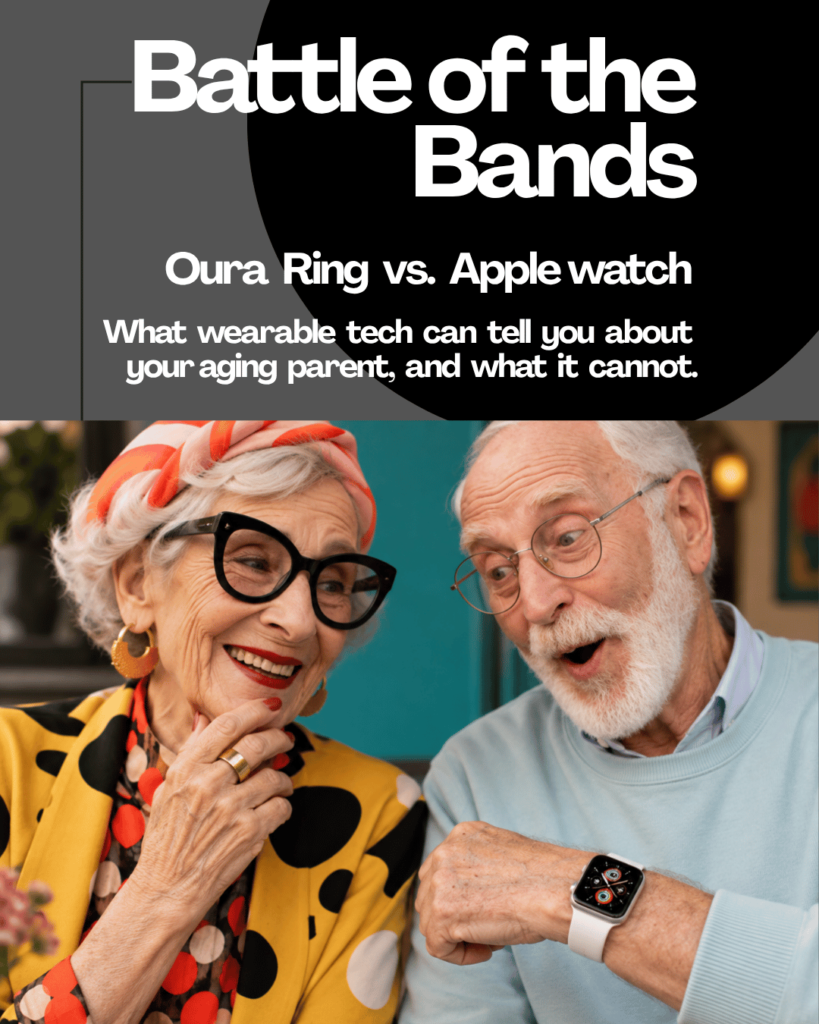
By Susan Chaityn Lebovits
Welcome to the wonderful world of adult children trying to figure out how their parents are actually doing, when they aren’t there to see for themselves. And now technology is offering another piece of the puzzle: wearable devices that can collect information about sleep, heart rate, activity, falls, blood oxygen and location. Could these be a useful addition to your caregiving team or should you take a pass?
Two of the most popular options are the Apple Watch and the Oura Ring. But before we turn Mom into a walking laboratory, there is a bigger question: Can this information actually help an adult child care for an aging parent? The answer, in my opinion, and with some important caveats, is yes.
But the most useful way to think about these devices is not as a way to monitor Mom, but as another source of gathering information that may help see that something has changed–and to catch an issue before it turns into a crisis. And that distinction matters.
What can these devices actually measure?
The heart: An Apple Watch can measure heart rate throughout the day and night, alert the wearer (and their caregiver) to unusually high or low heart rates, detect possible irregular heart rhythms, and—on compatible models—perform an electrocardiogram (ECG).
When researching this story I included only studies that were funded by companies with no vested interest in any of the products being tested.
A large 2026 systematic review in npj Digital Medicine looked at 82 Apple Watch validation studies involving more than 430,000 participants.
Read the full study The researchers found that the Apple Watch heart rate measurements were generally quite close to reference measurements. For detecting atrial fibrillation (AFib), pooled sensitivity was 79% and specificity was 91%.
This does not mean the Apple Watch can diagnose heart disease. It does, however, mean that it can potentially identify something worth paying attention to. And that is a theme you will see throughout this article: A wearable can be an early-warning system. It is not your mother’s cardiologist.
Sleep: Sleep may actually be one of the most useful things to watch over time.
Both the Apple Watch and the Oura Ring can provide information about sleep duration and patterns. But here’s where things get interesting. Neither device is a tiny sleep study strapped to your wrist—or finger.
Independent research shows that consumer wearables are considerably better at determining whether someone is asleep or awake than determining exactly how much REM, deep or light sleep they had.
A 2023 study comparing the Apple Watch Series 8 with laboratory polysomnography (the medical term for a formal sleep study) found that the watch was reasonably good at distinguishing sleep from wakefulness but much less reliable at identifying individual sleep stages. Read the study on PubMed
Oura Ring and older adults: A 2026 National Institutes of Health (NIH) – funded study specifically examined consumer sleep trackers, including the Oura Ring, in adults ages 56–80 and compared them with laboratory polysomnography. The researchers also found important limitations in sleep-duration and sleep-stage estimates. Read the study
So should we throw away the sleep data? No. We just need to use it differently.
If Mom’s watch tells you she got exactly 42 minutes and 17 seconds of deep sleep, I wouldn’t lose sleep over it (ta-dum). But if Mom normally sleeps about seven hours and suddenly begins sleeping five hours, waking repeatedly and becoming much less active during the day? Now I would pay attention. The change from her own baseline may be much more useful than the individual number. Could it be sleep apnea? A urinary tract infection (UTI)? Erratic blood sugar? Definitely worth a trip to her physician’s office.
Falls: This is where Apple Watch gets particularly interesting
For an older adult, the Apple Watch has one major advantage that the Oura Ring doesn’t: Fall Detection.
If the watch believes it is a hard fall, it can alert emergency contacts and call for local help.
Personally, I swatted a fly last week with such extreme force that my watch went off to question if I’d fallen. (Susan: 1, Fly: 0).
While the watch may not detect every fall, it can potentially add a meaningful layer of protection for someone who lives alone.
Independent research has found that wearable fall-detection performance varies considerably depending on the type of fall, body position and circumstances. So I never tell a family: “The Apple Watch will know if Mom falls.” But I do say: “The Apple Watch gives your family another set of virtual eyes if she falls.” Those are very different promises.
Emergency SOS: This is another place where Apple Watch moves beyond being a health tracker.
A cellular Apple Watch (one that has cellular access) can allow someone to contact emergency services without having their iPhone right next to them. This can be especially useful if a parent falls in the backyard, is unable to reach a phone, or has another emergency while alone. (Yes, there is an additional fee for this service). Again, it is not foolproof. But caregiving is often about layers of protection.
A medical alert system might be one layer. A neighbor might be another. Regular phone calls might be another. And an Apple Watch can potentially be another.
The wanderer : This is where the conversation gets more complicated. If a parent has memory loss, an Apple Watch with cellular capability and location services can potentially help family members determine where the person is. Independent research has found that GPS wearables can be feasible for people with cognitive impairment and can give caregivers useful information about where the person is going and how much they are moving around outside of the home.
GPS and dementia: Research funded by the National Institute on Aging has examined GPS wearables as a way to understand mobility and location patterns in people with dementia Read the study on PubMed
Some caregivers have reported greater peace of mind when they can locate a family member. But let’s be careful with our language.
An Apple Watch is not a dementia-wandering prevention system. GPS tracking can help locate someone. It cannot guarantee that a person won’t wander. And if your parent has significant cognitive impairment, you may want a purpose-built dementia safety system in addition to—or instead of—a smartwatch. And we should also have a conversation ASAP so please reach out to me here to see how we can prevent a crisis before one occurs.
Blood oxygen: Both Apple Watch and the Oura Ring can provide blood-oxygen information on compatible devices. While this sounds responsible and tech-forward, do not treat the number as a medical-grade pulse oximeter reading. An Apple Watch can provide blood-oxygen measurements, but those readings should be interpreted cautiously. In a 2026 controlled study, Apple Watch Series 7 tended to overestimate oxygen saturation compared with arterial blood-gas measurements (test that measures how well your lungs are putting oxygen into the blood and removing carbon dioxide).
The discrepancy became greater when oxygen levels were low. The researchers found that the watch sometimes reported reassuringly higher readings when actual blood oxygen was below the clinical threshold for hypoxemia (too little oxygen in the blood). So while wearable oxygen measurements may be useful as one piece of information, an Apple Watch should not replace a medical pulse oximeter when there is concern about someone’s oxygen level.
If Mom is short of breath and her watch says her oxygen is 94%, I would not tell her to relax because her watch says she’s fine. I’d use an appropriate medical device and, if necessary, contact her healthcare provider.
Where does the Oura Ring fit?
I like the concept of the Oura Ring, however, for a different kind of parent. You put a little ring on your finger and go about your day. Plus the battery is fabulous, eliminating the need for daily charging. The Oura Ring is particularly good at collecting information such as: sleep, heart rate, heart-rate variability, respiratory rate, temperature trends, activity, recovery, and blood oxygen.
For a relatively independent older adult, the Oura Ring can be a very unobtrusive way of establishing a personal baseline. But the Oura doesn’t have the same safety capabilities as the Apple Watch. No fall detection, no Emergency SOS, no cellular phone, no comparable location functionality for dementia-related wandering.
So if the question is: “How is Mom sleeping and recovering,” the Oura Ring can be very interesting.
If the question is: “What happens if Mom falls in the kitchen when nobody is home?” The Apple Watch has a significant advantage.
While wearable technology is rapidly improving, the research is not nearly as definitive as the marketing sometimes makes it sound.
One of the most important findings from the 2026 Apple Watch systematic review was that the average participant across the enormous body of research was about 41- years old. That’s a problem when we’re asking: How well does this work for an 87-year-old with arthritis, reduced circulation, multiple medications and occasional confusion?
We don’t have nearly as much research on that population. And older adults can present special challenges: thinner skin, reduced circulation, tremors, arthritis, swelling, difficulty charging devices, difficulty navigating tiny screens, cognitive impairment.
Which leads me to an important caregiving principle: The question isn’t whether Mom can master the technology, the question is whether the technology can be set up so Mom doesn’t have to. The most useful information may actually be the small trends that are picked up.
Let’s say your 87-year-old mother normally: Sleeps 7 hours, walks 5,000 steps a day, has a resting heart fate 68-72, goes outside most days, and as not fallen. You aren’t looking at her watch every morning like you’re running NASA. You’re establishing a baseline. Then something changes. She is suddenly: Sleeping five hours, walking 2,000 steps, staying inside, showing a persistent increase in resting heart rate, getting up repeatedly during the night.
The watch hasn’t diagnosed anything. But it has given you a reason to do some research. She may report: “My knee has been hurting.” Or: “I’m getting up a lot during the night to use the bathroom.” Or: “I’ve been feeling dizzy.” Or: “Oh, I forgot to tell you. I fell on Tuesday.” That’s where the wearable becomes useful. It may help you notice when something needs your attention.
My takeaway
If you asked me to choose one device for an aging parent who may become increasingly vulnerable, I’d lean toward the Apple Watch, particularly a cellular model. Not because it measures more things. Because it combines health information with something that can be incredibly important in caregiving: a way to get help.
If your parent is independent and the primary goal is quietly collecting information about sleep, heart rate, activity and other physiological trends, I think the Oura Ring is a very reasonable option.
And if Mom is the sort of person who would rather swallow a cactus than wear a smartwatch, the Oura Ring may win simply because she’ll actually wear it. And that matters. The most sophisticated wearable in the world is not particularly useful if it is sitting in the junk drawer next to the instruction manual.
The Discussion
Be very mindful about how to introduce any wearable to your aging parent. Nobody wants to feel as though their adult children are keeping tabs on them.
Instead of: “We’re going to monitor you.” Try: “We thought this might give us all another way to make sure you’re okay—and maybe give you some extra protection if something happens.”
And then ask permission. Because the goal isn’t to turn an aging parent into a collection of data points. It’s to give the family one more piece of information that might help them notice when something has changed. And sometimes, that little bit of information can be the nudge that gets a family to say: “Maybe we should check in more frequently.”
And that may be the most useful technology of all.
Research behind this article
Apple Watch and health measurement:
Lambe et al., 2026, npj Digital Medicine. A systematic review and meta-analysis of 82 Apple Watch validation studies involving more than 430,000 participants.
Read the full study
Apple Watch and older adults:
A study of older emergency-department patients who had experienced falls examined whether they could successfully use an Apple Watch and found that participants could use the device but that some required assistance with more complex functions.
Read the study on PubMed
Apple Watch and sleep:
A 2023 independent study compared Apple Watch Series 8 with laboratory sleep testing and found better performance for distinguishing sleep from wakefulness than for identifying individual sleep stages.
Read the study on PubMed
GPS and dementia:
Research funded by the National Institute on Aging has examined GPS wearables as a way to understand mobility and location patterns in people with dementia.
Read the study on PubMed
Oura and older adults:
A 2026 NIH-funded study specifically examined consumer sleep trackers, including Oura, in adults ages 56–80 and compared them with laboratory polysomnography. The researchers found important limitations in sleep-duration and sleep-stage estimates.
Read the study
Have a question? Let’s chat. reach out to me here to book a free 30-minute meeting.