Should AI become an extra set of eyes on your parents?
By Susan Chaityn Lebovits
Should AI become part of your family’s care team?
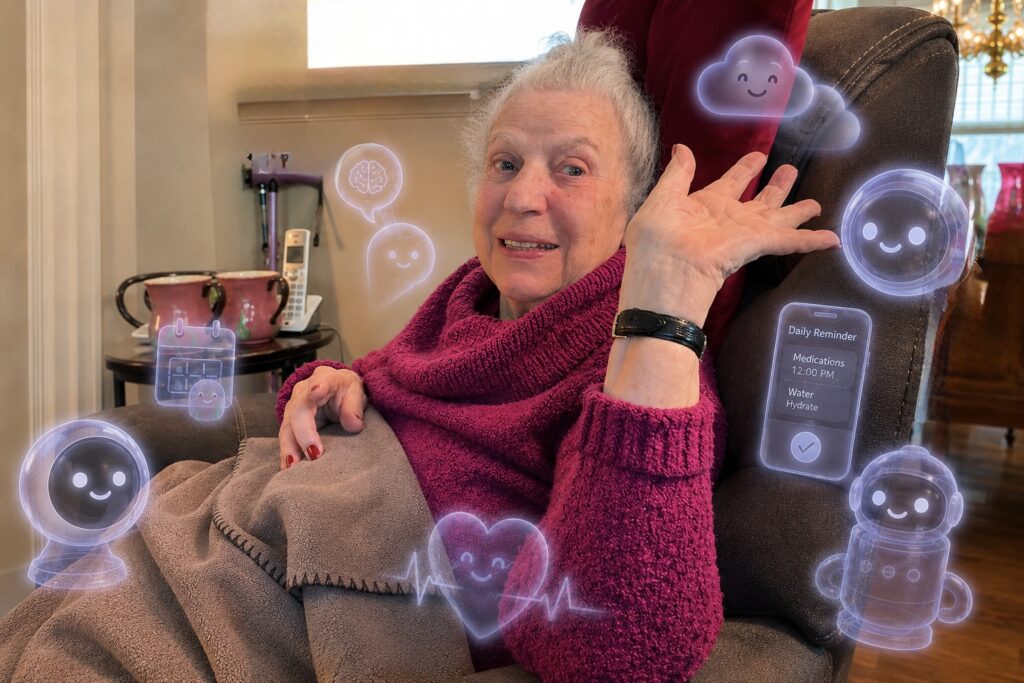
A new generation of tools is helping families answer questions like: Is mom in the bathroom more frequently? What happens when the home health aide leaves? Has something changed that I should know about? AI devices can notice changes in behavior, send reminders, provide companionship, or help coordinate care.
For years, technology has been striving to make caregiving easier. But this new generation of tools is going beyond the “I’ve fallen and I can’t get up” emergency buttons and video cameras. AI agents—systems that can collect information, notice patterns, identify potential concerns and alert family members or care providers are here to stay.
These systems are starting to answer the important question: “Is there something that needs to be addressed?”
What Is an AI Care Agent?
Think of an AI care agent as a digital assistant with a specific caregiving job.
Depending on the product, it might:
● Notice that your mother is sleeping much more than usual.
● Detect changes in your father’s daily activity, including more frequent trips to the bathroom.
● Remind a parent about medication, hydration or an appointment.
● Alert you when your parent reports pain or feeling unwell.
● Track questions and medication information for the whole family.
● Send a summary of important changes instead of requiring you to monitor constant streams of information.
● Help coordinate communication among siblings and caregivers.
AI in the caregiving space is an emerging field, and the products are very different from one another.
Some are designed to monitor.
Some are designed to communicate.
Some provide companionship.
Others help professional caregiving organizations coordinate care.
These distinctions matter. Read on to learn more about the various types of AI that families are using.
1. The AI That Notices Changes
Systems such as
Sensi use AI to identify unusual events and changes in an older adult’s environment or routines. Personally, the health care company that I have trusted to help me care for my mom over the last nine years has recently employed Sensi. “Virtual care really enhances the incredible work that our caregivers do every single day by getting smarter over time and catching things that might otherwise be missed,” says Terri Sajkowski, RN, BSN, CMC, founder and CEO of
Always Responsive Home Care based in Monroe Township, New Jersey. “Whether it’s sending an alert about an early sign of illness or detecting a fall the second it happens, it lets us step in proactively, long before a small issue turns into a major emergency.”
The potential benefit is obvious: family members cannot be everywhere, and caregivers, even on-site live aides, cannot always be in the same room 24/7.
But there is also an important question: How much monitoring is too much? Would you or your parent feel a sense of invasion? An always-on system may provide reassurance to an adult child who lives across the country while feeling intrusive to the person being monitored. Or perhaps this would give everyone, including the person being monitored, a sense of comfort.
Before considering this type of technology, families should have an honest conversation about consent, privacy and exactly who will have access to the information.
2. The AI Companion
Products s
uch as ElliQ take a very different approach than simply watching and reporting. It acts as an interactive AI companion. ElliQ can encourage your parent to exercise, provide reminders, support social connection and allow family members to stay in touch. For some older adults, this may feel less like surveillance and more like an additional source of support. But it is important to remember that AI companionship is not the same as human companionship. A device may remind your father to call his friend, but It cannot replace the value of having a friend and the value of time spent in-person.
3. The AI That Looks for Patterns
One of the most promising uses of AI may be its ability to notice gradual changes that are easy for humans to miss. A system such as
CarePredict, for example, analyzes changes in everyday behavior. For example, perhaps it’s not a dramatic emergency that your mom has been afflicted with, but instead, over several weeks, she is moving less, her sleeping patterns have changed, she is using the restroom more frequently, or she has been less socially engaged.
Any one change might not seem important, however together, these signs may tell a story—before a family reaches a crisis.
4. The AI Care Coordinator
This may be especially useful for families with several siblings.
New services are exploring the idea of an AI assistant that helps organize family caregiving conversations instead of a group text thread:
“Who talked to Mom’s doctor?”
“Did anyone refill Dad’s prescription?”
“When is the next appointment?”
An AI care coordinator could potentially track information, organize tasks and summarize what the family needs to know. Currently, these programs already exist in apps like
Caring Village and
Connected Caregiver, but must be entered manually by one family member. The goal is not to replace the family member making decisions, the goal is to reduce the mental load carried by the person who is currently tasked with trying to remember everything.
5. The Simple Digital Check-In
Sometimes sophisticated AI is not necessary. A simple daily check-in system like
Elder Voice or
SeniorTalk can alert family members if a parent does not respond. For a healthy parent living independently, that may provide exactly the right amount of support without installing sensors or collecting large amounts of personal information. The best technology is not necessarily the most advanced technology, but rather the technology that solves your family’s actual problem without creating new ones.
Questions to Ask Before Bringing AI Into Your Parent’s Care
- What specific problem are we trying to solve?
- Are you worried about falls?
- Medication?
- Isolation?
- Changes in memory?
- Family communication.
- Does my parent understand what information will be collected? Do they consent?
- Who will receive alerts—and who is expected to act on them? This is critical as an alert is only helpful if someone knows the protocol.
- What happens if the technology is incorrect—or fails? AI should be an additional layer of support, not the only safety plan.
- Will this make my parent feel safer, or will it feel invasive?
The answer may be different for every family. When my father-in-law became more physically fragile, he requested that the family install cameras in his apartment bedroom, even though he had 24/7 care available for emergencies.
AI Will Become a Mainstream Tool
AI will never and should never replace adult children, professional caregivers or geriatric care managers. But it’s here to stay, and I do believe it will become another member of care teams. Not a decision-maker, and not a substitute for human judgment, but perhaps an extra set of digital eyes. An AI system can notices if something has changed – a parent hasn’t been active, sleeping patterns are inconsistent, toileting has increased, sounds of pain or discomfort are picked up, or perhaps a medication question still hasn’t been resolved.
For families trying to care for someone they love while also working, raising children and managing their own lives, additional information can make a big difference in care planning. The challenge will be learning to use these tools without sacrificing privacy, independence and human connection.
Have a question about bringing AI into your parent’s home? Have a question that’s been on your mind?
Let’s talk.